Japan Arrests Staffing Firm Chief Over Alleged Crypto Laundering of Scam Funds
Japanese police allege an underground crypto brokerage known as 'Aitaiya' turned social media investment scam proceeds into digital assets before routing them offshore.
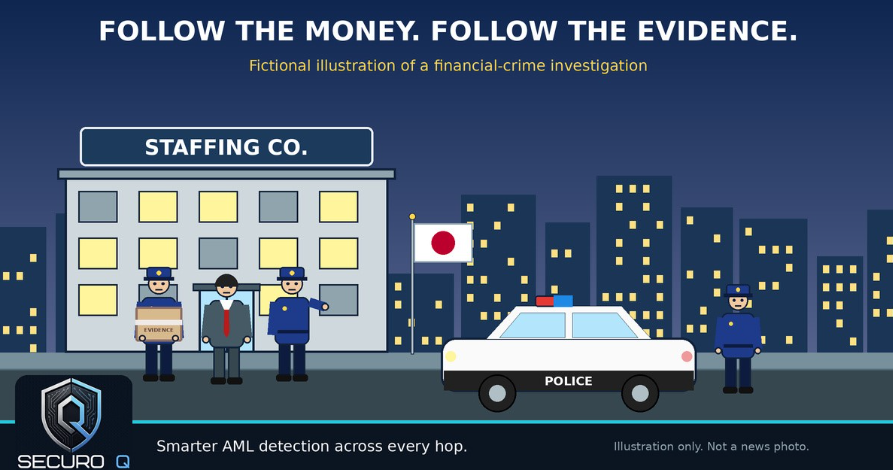
"Japanese police allege that an underground crypto brokerage turned victims' payments from social media investment scams into digital assets and sent them back to the fraudsters."
A joint task force including the Tokyo Metropolitan Police and cybercrime units arrested the 36-year-old chief executive of an Osaka Prefecture staffing company and two others, as reported by the Asahi Shimbun. Police also plan to refer the company to prosecutors. The chief executive is held on suspicion of concealing criminal proceeds under Japan's Organized Crime Punishment Law. These are allegations, and no one has been convicted.
Investigators say the group colluded with a scam gang on 16 February 2024. The suspects allegedly received 4.4 million yen, including money taken from victims of social media investment scams, into a company bank account. The money was then converted into digital assets and routed back to the fraudsters.
Police believe the group operated as an unregistered broker of the kind known in Japan as 'Aitaiya'. Three other people were also arrested in connection with the scheme, including a 45-year-old Tokyo man alleged to be the main middleman. Tokyo police suspect six people, acting as a company, laundered about 91 million yen from 30 victims across the country by the same method.
How the Alleged Chain Worked
Police describe a route that, on the surface, looked like ordinary trading:
- Victims Pay: People targeted by social media investment scams send money into a corporate bank account.
- Cash Becomes Bitcoin: The suspects allegedly used the cash to buy Bitcoin on domestic Japanese exchanges.
- Funds Go Offshore: The Bitcoin was transferred swiftly to overseas virtual asset exchanges.
- Bitcoin Becomes Tether: On overseas venues, the Bitcoin was swapped for the dollar-pegged stablecoin Tether (USDT).
- Money Returns to Scammers: The Tether was funnelled back to the scam ring through a network of brokers, in some cases reportedly on the day the victim's money arrived.
Reports say police allege the company kept a commission of about 1%. The case sits within a growing problem: Japan's National Police Agency recorded 183.4 billion yen in losses from social media investment and romance fraud in 2025, up 44% on the year.
Where the Gaps Are
Each step in the chain was allegedly handled by a different party, so no single institution saw the whole picture. Four weaknesses stand out:
- Brokers Outside the Net: Unregistered brokers avoid the identity checks and monitoring that licensed exchanges must run. The bank account that receives the victims' money may be the only regulated checkpoint.
- Profile Mismatch: A staffing company taking payments from people with no link to staffing is the kind of pattern monitoring should question. Static business profiles can miss it.
- Hops Across Institutions: Cash to Bitcoin, Bitcoin offshore, then Tether: each hop sits with a different firm. The Financial Action Task Force (FATF) warned in July that offshore providers are a growing gap, and that most illicit on-chain activity it identified now involves stablecoins.
- Speed: If funds return to scammers within hours, overnight batch monitoring arrives too late.
What It Means for SecuroQ
SecuroQ, which counts banks, fintechs, payment firms and crypto platforms among its customers, serves both ends of this chain: the bank account where the money lands and the platform where it becomes crypto. According to its website, its four engines map to the gaps above: Customer Engine links a company to its officers, intermediaries and related accounts; Risk Engine flags mismatches between stated business and account activity; Transaction Engine catches many-to-one inflows followed by rapid conversion; and Investigation Engine reconstructs counterparty links into court-defensible intelligence.
Closing the Gaps: A 5-Part Framework
- Profile Business Purpose: Record what each business customer should be doing, then alert when real activity departs from it, such as investor-style payments into a staffing firm's account.
- Build Real-Time Scenarios: Flag many unrelated individuals paying one corporate account, followed by fast buying of crypto or transfers to brokers. Alert in real time, not overnight.
- Watch the Crypto Side: Exchanges should screen wallets, apply Travel Rule checks and use blockchain analytics to spot new accounts that swap into stablecoins and withdraw offshore.
- Link and Share: Connect customers, officers and counterparties inside the firm, and use public-private channels to share typologies, as the FATF recommends.
- Report the Whole Chain: A suspicious activity report that sets out amounts, timings and every hop across fiat and digital assets is far more useful to investigators than a single flagged transfer.
A framework review, such as SecuroQ's Financial Crime Health Check, can show which gaps a firm has before a supervisor asks.
"Sources: Tokyo Reporter (citing Asahi Shimbun); crypto.news (citing Jiji Press, TBS, FNN and ANN); FATF Targeted Report on Virtual Assets & Stablecoins (March & July 2026); Nippon.com (Japan NPA 2025 Statistics); SecuroQ (securoq.com)."
Detect Real-Time Crypto Velocity & Corporate Inflow Mismatches
Discover how SecuroQ's Transaction and Risk Engines flag many-to-one retail inflows and instantaneous digital asset off-ramps before capital leaves regulated perimeters.